
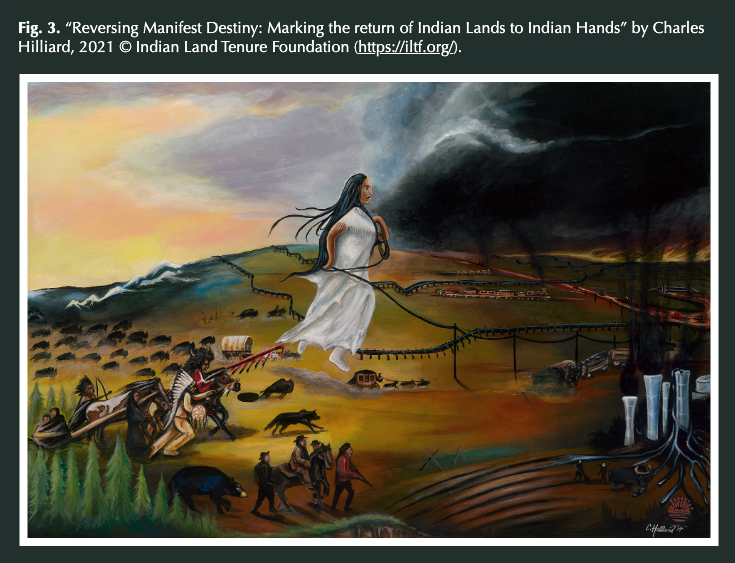
“Overall, developing an understanding of the intersections between settler colonialism and conventional conservation generates pathways toward healing Indigenous landscapes and lifeways.”
Pursuing strategies for support social and ecological resilience and recovery requires cultivating a shared understanding of the full scope of settler colonial legacies, which continue to impede justice efforts in conservation and environmentalism more broadly. However, although decolonial resources are growing, they remain scattered across various bodies of work and disciplines, often failing to be incorporated into conventional conservation understanding. In alignment with these decolonial needs, Layden et al. provide a brief primer of the origins of settler colonial conservation, resulting broad-scale disparities, and pathways toward a more just conservation future. Their synthesis draws from diverse bodies of work, across disciplines and expert voices, and provides an entry point for cultivating a deeper understanding of justice and decolonization in conservation while centering the histories, realities, and futures of Indigenous Peoples worldwide.
Access the article here: https://ecologyandsociety.org/vol30/iss1/art33/
CITATION: Layden, T. J., D. M. David-Chavez, E. Galofré García, G. L. Gifford, A. Lavoie, E. R. Weingarten, and S. P. Bombaci. 2025. Confronting colonial history: toward healing, just, and equitable Indigenous conservation futures. Ecology and Society 30(1):33.
https://doi.org/10.5751/ES-15890-300133