
We will continue to update this page with additional resources
Dear Mountain Sentinels community,
Our hearts are with the people of the Tibet-Nepal border area and downstream who were impacted by the tragic floods that devastated towns on the morning of August 26th. Rising temperatures triggered the collapse of a glacier on Langtang Lirung in the Himalayas. The resulting debris flow and flooding swept through populated places downstream. Tragically, nearly 1,400 people have died and more than 5,000 are missing across Nepal and Tibet – an unfathomable loss. Now the region faces ongoing uncertainty and the difficult journey of recovery. We know they have the strength and ingenuity to find the way forward. We stand in strength and solidarity with the people of the Himalayas and the Tibetan Plateau.
With so many partners, colleagues, and friends in Nepal and Tibet impacted, we are sharing some of their thoughts and suggestions to support relief and recovery efforts for communities most devastated, and ideas for the future.

From our partners

From Director General Pema Gyamtsho, and our partners at The International Centre for Integrated Mountain Development (ICIMOD):“The speed and force of the flood, carrying large volumes of water, sediment, and boulders through the Bhote Koshi and Trishuli river systems, are deeply concerning. The potential for impacts further downstream is a reminder of how quickly a hazard in the mountains can become a wider regional concern. It also reinforces the importance of timely information, early warnings, preparedness, and coordinated action…
…The decisions we make today will shape the safety and well-being of generations to come. The people of the HKH [Hindu Kush Himalaya] deserve nothing less than our collective commitment to building a safer, more resilient future…
…In moments such as this, solidarity must be more than words. It must translate into action, cooperation, and support.”
– Director General Pema Gyamtsho
Read Director General Pema Gyamtsho’s and ICIMOD’s full statements here.

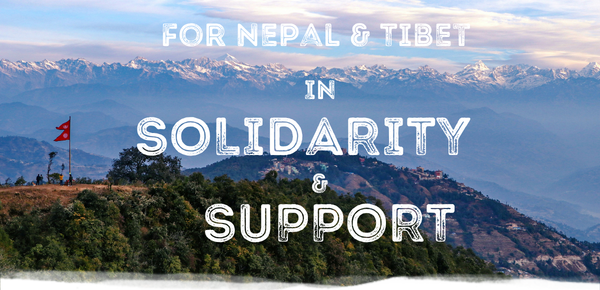
Photo of Gatlang Village, Rasuwa District, Nepal in 2025. Photo credit: AP Tolang.
Ways to help
It will take a long time for communities on the Tibetan Plateau and the Himalayan region to rebuild and recover. The cost of reconstruction is estimated at $4–$5 billion, equaling nearly a tenth of Nepal’s GDP. We have been in contact with colleagues on the ground in Nepal and have compiled a list of organizations that they have suggested would be effective direct aid.
Please take action to support these mountain communities and prepare for future resilience.

From our colleagues:
- Shenpen Nepal, the service wing of Rangjung Yeshe Institute/Ka-Nying Shedrup Ling Gompa.
- #WeHelpNepal, a network supporting locally-led, peer-to-peer Nepal Disaster relief efforts.
- Dolma Foundation Rasuwa Floods Emergency Response.
The Government of Nepal has an official Prime Minister’s Disaster Relief Fund, which differs from mutual aid funds. These funds have been dispersed through the National Disaster Risk Reduction and Management Authority for victims affected by the flood.
The New York Times has also compiled a guide to supporting victims of the flood.

Global Mountain Connections

Photo: Julia Klein
Scientists understand that the catastrophic event in Nepal is connected directly to climate change. Rising temperatures in the region have destabilized glaciers, including the nearly 90,000 located in the Himalayas. Nepal is expected to be disproportionately hard-hit by the impacts of climate change, despite being responsible for only 0.1% of global emissions.
While glacial collapse triggered the Nepal disaster, related climate effects on glaciers include glacial lake outburst floods (GLOFs): a sudden, catastrophic release of water from a lake that has formed at the edge of a retreating glacier. These events are among the most destructive floods on Earth — and 15 million people globally are threatened by potential GLOF events. We are reminded of our colleague and friend, Saúl Luciano Lliuya and his fight for climate justice in the Andes.
The Nepal-Tibet floods are thus a devastating example of how climate change is impacting global mountain communities, and reminds us that the work of our fellows, scientists, community leaders, and practitioners in mountain regions around the world is more vital than ever.
Additional Resources

- We co-developed this podcast with Livable Future. Our colleague Basanta Shrestha, former Director of Strategic Cooperation at ICIMOD, discusses some of the distinct challenges facing the Himalayan region: Listen now.
Learn more about the Livable Future podcast collaboration here.

- Above is a figure from a paper we authored following the 2015 Earthquakes in Nepal. We wrote this paper with practitioners on the ground in Nepal and with several mountain interdisciplinary scientists. Through synthesis from mountain case studies, we explore how to strengthen community-based and ecosystem-based disaster risk reduction in mountains. Read the paper.
Read more on the Mountain Sentinels blog.


- The most recent issue of the Stanford Social Innovation Review includes lessons learned about “trust-based recovery” in Appalachia, USA. While the context and scope of the disaster is different from the situation in Nepal, key messages are relevant to mountains around the world. Here are some important excerpts from that article.
.
“In Appalachia, trust is often quietly accrued through years of presence, rather than by position or title, something accumulated through enduring relationships, repeated interactions, and shared experience. Communities learn whom to trust by who shows up; who follows through; who exercises sound judgment under pressure; and, most important, who can be counted on when formal systems are delayed, incomplete, or absent. However informal, this accumulated body of evidence serves as a dense record of character, competence, reciprocity, and reliability, enabling fast and adaptive decisions that even well-intentioned bureaucratic systems aren’t designed to make at the speed catastrophe requires.”
“While trust is often viewed as a “soft” asset, it is operational infrastructure in marginalized economies, even a form of civic power. Any region that wants to survive compounding crises amid disinvestment needs to start investing in it now, before a disaster forces the question.”
“The capacity to blend and stack capital around community-led priorities is a muscle that strengthens with use and is built during blue skies, so that when disaster strikes, communities and their capital partners can move together quickly. By formalizing these networks, similar communities can move from a resilience of necessity to resilience that is resourced and chosen.”
By Lauren Sowers, Kalista Pepper, Ryan M. Eller & Andrew Crosson
Read the full article here in the Stanford Social Innovation Review.
.
We will continue to follow up with periodic notes – especially from those on the ground – and update this list of resources and actions in the weeks and months to come. If you have any resources or items you want to share, please do contact us at [email protected].
In Peace and Solidarity,
The Mountain Sentinels Team
